 Shoopy
 Ecommerce platforms for multi-location retail in India: what each is built for
Shopify, WooCommerce, Zoho, BigCommerce, GoFrugal and Shoopy sorted by the kind and size of business each serves — read from their own pages, August 2026.
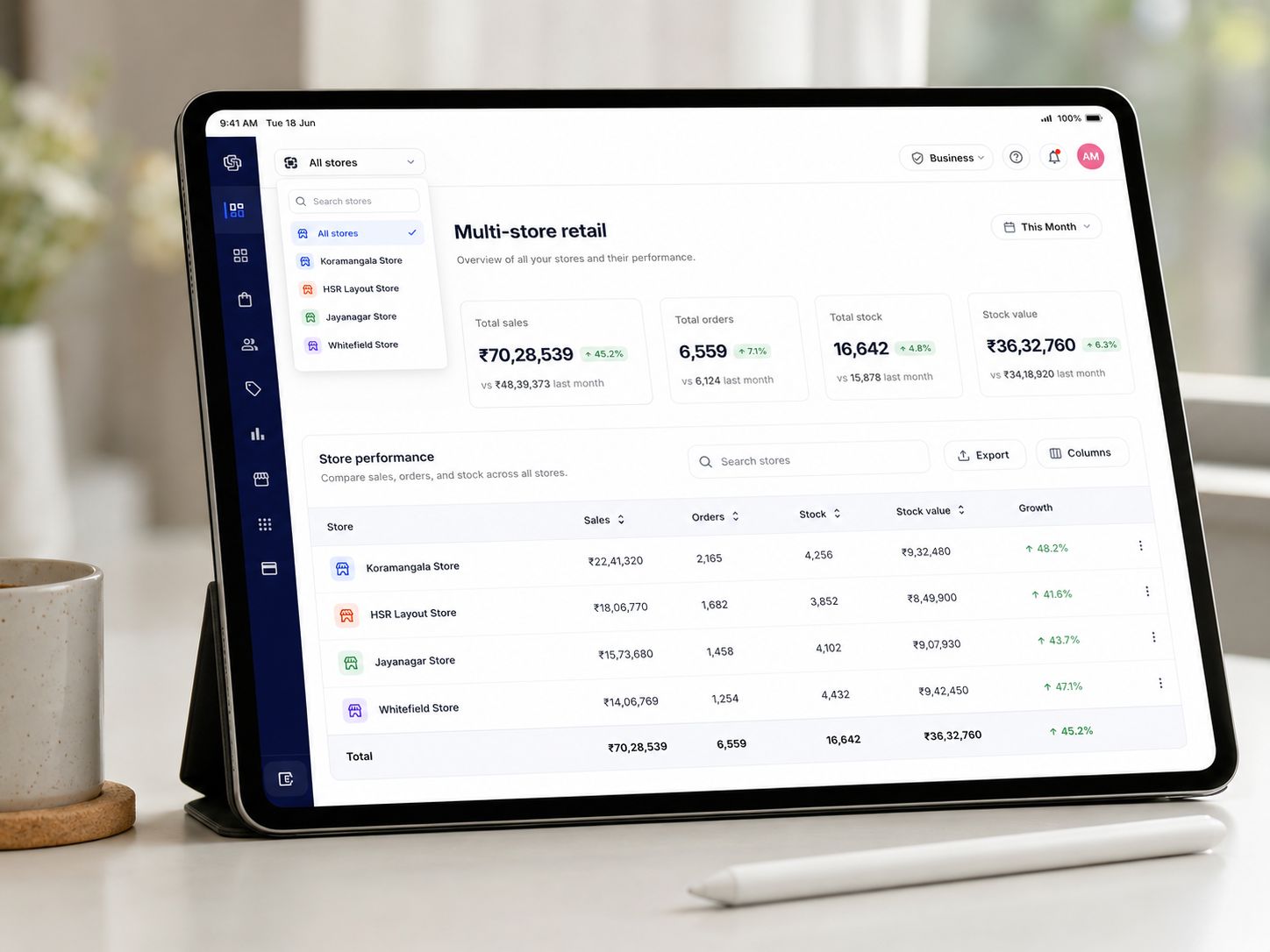
“Ecommerce platform for multi-location retail” is one search phrase for two different products. One runs several separate online stores — a website per brand or per country — from one admin. The other runs one online store for a business that has several physical shops, with stock counted at each shop. For most Indian retailers the phrase means the second: three outlets, one brand, one website, and a stock count that is right at every counter. Searches also call that second product “multi-store ecommerce software”, “store-level inventory” or “ecommerce software for retail chains”. It is the same need.
This article sorts the platforms a search returns by which of those two jobs each is built for, and for what size of business. Everything below is read from each platform’s own public pages in August 2026. Prices change; check the linked pages before you decide.
The short version
Sorted by the kind of business, not by rank:
- A second shop up to a few dozen outlets, one brand, selling online and at the counter: Shoopy — stock per location and counter billing are in the plan.
- An online-first brand adding a few counters: Shopify, with POS Pro budgeted per location.
- Already on Zoho Books or Zoho CRM: Zoho Commerce with Zoho Inventory — two products.
- A developer-led store that wants full control: WooCommerce plus a multi-inventory extension.
- A counter-led chain, online store as an addition: GoFrugal.
- A hundred-plus stores, or several warehouses feeding them: Shopify Plus or BigCommerce Enterprise.
The reasoning, with sources, follows.
What multi-location retail actually needs
Before comparing names, six checks separate a platform built for several shops from a single-shop platform with a “locations” setting:
- Stock per location — store-level inventory. The same SKU can show 200 in the warehouse and 12 in the flagship shop, and the system knows which is which.
- One catalogue, central prices. Products, photos and prices are set once. Only stock differs by location.
- Availability that follows the customer. The customer sees what the shop serving their area can actually supply.
- The order reaches the shop that fulfils it — not a central inbox that someone forwards by phone.
- Staff see their own location. A branch manager sees their branch. The owner sees everything.
- Counter and online sell from the same count. A sale at the till and a sale on the website never promise the same unit twice.
And one cost question: what does shop number four cost? Some platforms price locations into the plan. Some charge per location per month. Some need an extension. It is the difference between a setting and a budget line.
Platforms, and what each is built for
Shopify
Shopify’s India pricing page lists 10 inventory locations on Basic, Grow and Advanced, and 200 on Plus. Paid yearly, those plans are ₹1,499, ₹5,599 and ₹22,680 a month (paid monthly: ₹1,994, ₹7,447 and ₹30,164); Plus starts at ₹1,75,000 a month on a three-year term. The per-location cost starts at the counter. Every paid plan includes what Shopify calls casual in-person selling; POS Pro — staff roles, inventory management, returns at any location — is ₹7,000 a month for each POS Pro location. A three-shop retailer on Grow, paid yearly, who wants POS Pro at every counter pays ₹5,599 + 3 × ₹7,000 = ₹26,599 a month before payment-provider fees.
Built for: online-first brands adding a few counters; Plus for large chains. Our page-by-page comparison is at Shopify vs Shoopy.
WooCommerce
WooCommerce is a free plugin for WordPress. Its stock setting is one quantity per product: “You enter quantities, and WooCommerce subtracts items as sales are made or orders are returned” (Products settings), with no mention of locations. Its own guide to running multiple stores points to WordPress Multisite — one installation, several separate stores — and to extensions. Stock per location comes from the marketplace: for example Addify’s Multi Inventory Management (₹12,430 a year) adds “multiple inventories per product based on location, warehouse, stores”. Hosting, security and updates are yours to run.
Built for: businesses with a developer who want full control and are happy to assemble the multi-location piece themselves.
Zoho Commerce and Zoho Inventory
This is two products. Zoho Commerce’s plan comparison lists 3 inventory locations on its Premium and Plus plans, with more available as a per-location monthly add-on from Premium up. The multi-warehouse work — transfer orders, dispatch from the nearest warehouse — lives in Zoho Inventory, priced in India from ₹999 a month with 2 locations to ₹7,499 with 10, plus a locations add-on at ₹600 a month, all billed annually and excluding GST (Zoho Inventory pricing).
Built for: businesses already on Zoho Books or Zoho CRM that want the suite. Expect to run and pay for two products.
BigCommerce
BigCommerce’s developer documentation on inventory locations says locations “allow merchants to track product inventory across multiple physical or virtual locations”, with limits by plan: up to 4 on Standard, 5 on Plus, 8 on Pro, and 100 on Enterprise. Its pricing is not on the page we read; check the plan page for your country.
Built for: mid-market and enterprise online stores. If you bill at a counter, check how that would connect before you commit.
GoFrugal
GoFrugal describes itself as retail POS software and lists multi-outlet retail management on its retail page: “Set uniform outlet-wise pricing, track stock movement, and oversee sales and purchases across all locations in real time.” It starts from the counter — billing, purchase, stock audit — rather than from the online store. Prices are not on the page.
Built for: chains that run from the billing counter and the back office, with the online store as an addition.
Shoopy
Shoopy is an India-first ecommerce platform built for the second meaning of the phrase: one online store, one catalogue and price list, and stock counted per shop, outlet or warehouse. The website, the branded apps and each shop’s counter billing sell from that location’s own count. A Location Admin sees only the locations they run; Owners and Admins see every location and the rolled-up dashboard. Multiple store locations come with the Business plan, which also carries 25 staff logins. Plans and yearly prices are on the pricing page; no per-location charge is listed.
Ladachi Kulfi runs around 25 outlets on one Shoopy store: the customer’s pincode picks the outlet that serves their area, that outlet fulfils the order, and head office takes over if it cannot. Shoopy can support the same location-based setup for other networks, and the same model serves retail chains and franchises: one brand and price list from the centre, each outlet running its own stock, orders and fulfilment. One boundary, stated plainly: there is no built-in stock transfer tool. Moving units is Stock Out at one location and Stock In at the other — the steps are in the location-wise inventory guide.
Built for: a second shop up to a few dozen outlets under one brand, selling online and at the counter from the same stock.
A note on Dukaan
Searches for India often surface Dukaan. As of August 2026 we could not find per-location stock or multiple store locations on its pricing, features or enterprise pages. If you are considering it, ask directly.
Side by side
| Platform | Built for | Stock per location | What location number four costs | Counter billing |
|---|---|---|---|---|
| Shopify | Online-first brands adding counters; Plus for large chains | Yes — 10 locations on Basic to Advanced, 200 on Plus | Inside the plan limit; POS Pro is ₹7,000 a month per location on top of the plan | Casual selling included; POS Pro is the add-on |
| WooCommerce | Developer-led stores that want full control | Via an extension (Addify, ₹12,430 a year) | The extension licence; hosting is yours | Not stated on the pages we read |
| Zoho Commerce + Inventory | Businesses on the Zoho suite | 3 in Commerce Premium and Plus; 2 to 10 across Inventory plans | Per-location add-on in Commerce; locations add-on ₹600 a month in Inventory | Not stated on the pages we read |
| BigCommerce | Mid-market and enterprise online stores | Yes — 4, 5, 8 or 100 by plan | Inside the plan limit; see its plan page | Not stated on the pages we read |
| GoFrugal | Counter-led chains | Yes — outlet-wise stock and pricing | On quote | Yes — it is POS software |
| Shoopy | A second shop up to a few dozen outlets, one brand, online and at the counter | Yes — every SKU counted per location | Business plan; no per-location charge listed | Yes — included |
“Not stated” means exactly that: the pages we read in August 2026 did not say. Ask the vendor.
Which platform is best for multi-location retail? Decide by size
- One shop today, a second one planned? Choose a platform where location two is a setting, not a project — and check that counter billing is part of the plan, not a per-location add-on.
- A few outlets to a few dozen, under one brand? You are the second meaning of the phrase. Test three things with your own products: availability by the customer’s location, what a branch manager can and cannot see, and the price of shop number four. That is what Shoopy is built for — see how multi-location retail runs on Shoopy and how Ladachi Kulfi does it.
- A hundred-plus stores, or several warehouses feeding them? That is the enterprise tier — Shopify Plus, BigCommerce Enterprise. Bring the requirements to those vendors.
- Several brands or countries, each with its own website? That is the first meaning: multi-storefront. Shopify runs several stores under one account; WooCommerce does it with Multisite.
Questions people ask
What is multi-store ecommerce software?
The term is used two ways: software that runs several separate storefront websites, and software that runs one online store for a business with several physical shops, with stock, staff and fulfilment managed per shop. Check which one a vendor means before you compare prices.
Which ecommerce platforms have store-level inventory?
From their own pages in August 2026: Shopify (10 inventory locations on Basic to Advanced, 200 on Plus), BigCommerce (4 to 100 locations by plan), Zoho Commerce (3 locations on Premium and Plus, with Zoho Inventory for warehouse work), GoFrugal (outlet-wise stock and pricing) and Shoopy (every SKU counted at every location). WooCommerce needs an extension for it.
Which ecommerce software suits a retail chain in India?
It depends on the size of the chain and where it sells. A chain that runs from the billing counter, with the online store as an addition, fits GoFrugal. A chain that sells online and at the counter from the same stock, from a second shop up to a few dozen outlets, fits Shoopy. A hundred-plus stores or several warehouses is enterprise territory: Shopify Plus or BigCommerce Enterprise.
Does Shoopy support multiple store locations?
Yes. Multiple store locations come with the Business plan, with 25 staff logins. Every SKU keeps its own count at each location, Location Admins see only their own locations, and the website, apps and counters sell from the same count. There is no built-in transfer tool: moving stock is Stock Out at one location and Stock In at the other.
Still deciding? Book a demo and see the second location bill, count and report without a second system.